
Guide
Why Your Garage Door Keeps Jumping Track in Kent
Kent Garage Door Co explains why doors here jump track: aging 1962-2005 hardware, cold-moderate freeze-thaw cycles, and worn rollers. No guesswork, no invented numbers.
Local detail
What It Costs
We're not going to post a flat number here, because it isn't honest. A door that's slipped one roller off a bent section of track is a different job than a track pulled loose from the jamb on a house with original hardware from the 1962-2005 building era that makes up most of Kent's stock. Some jobs are a bracket tightened and a roller swapped. Others need new track on both sides because the rail itself is bowed, and once the rail's bowed you're not straightening it back into spec - you're replacing it.
What we can tell you is what drives the number up or down: whether the track is bent or just knocked out of alignment, whether the rollers are the original plastic ones from a build era where that was standard, and whether the door's cables and hardware are old enough that fixing the track just exposes the next thing that's about to fail. We look at the job in person before we say a number, because guessing over the phone and then changing it at the door is how a homeowner loses trust in a company fast. That's the limitation, plainly stated - we don't quote track repairs sight unseen.

The area
What to Check
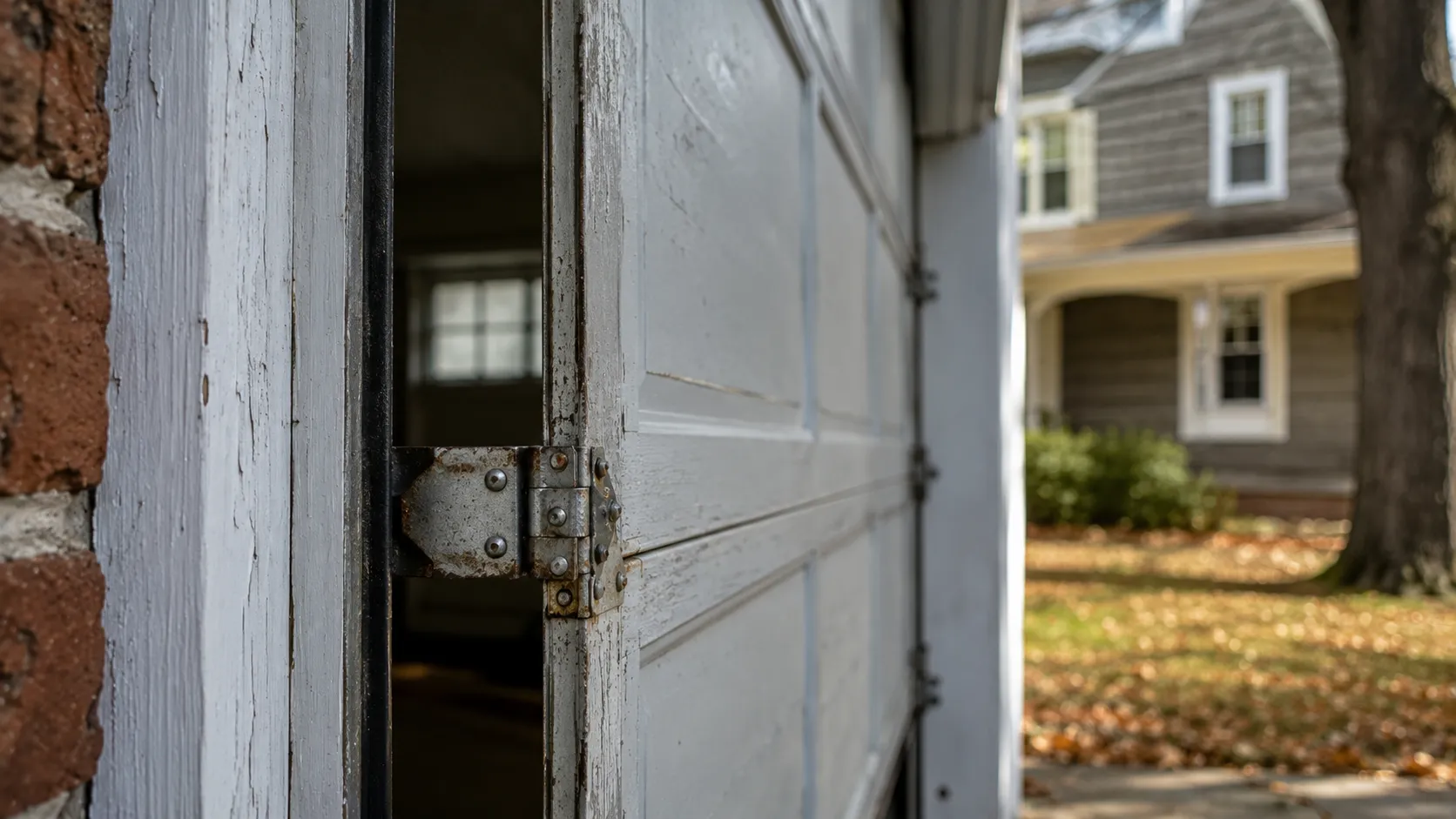
Before you call anyone, look at three things. First, the track itself - stand back and sight down each rail. A rail that bows out or in, even slightly, is why rollers pop free on the way up or down. Second, the mounting brackets where the track bolts to the wall studs or jamb. On a lot of Kent-area houses built in that 1962-2005 window, those lag bolts have been in the same wood for decades and they back out a little at a time until the track has play in it. Third, the rollers themselves - crack a plastic roller in half and the door will ride rough right before it jumps the rail entirely.
What you shouldn't do is force the door back onto the track yourself while it's under spring tension. A door hanging half off its rail is still attached to cables and a spring that can move without warning. Check the track, check the bolts, check the rollers - then call it in if any of the three look off. That's the honest extent of a homeowner inspection; the alignment fix itself takes a level and torque wrench, not a guess.
What we find
The Situation
Most doors in Kent's service area sit on track hardware installed sometime between 1962 and 2005, with the median build year landing around 1983. That's not a small pocket of the market - it's the dominant stock across the 43 named areas we cover, from Lakeland North five miles out to Medina sixteen miles away, and the track age problem shows up the same way across most of them. A door installed in the 1980s wasn't engineered to today's roller and bracket standards, and thirty-plus years of daily open-close cycles wears the original hardware exactly where you'd expect: at the bolts and at the rollers.
Across the service area's 228,944 households and 118,902 owner-occupied houses, a lot of those original tracks have never been swapped out - a door works until it doesn't, and nobody replaces track hardware on a schedule. With a median household income of $115,750 here, most owners we talk with choose to replace worn track hardware outright rather than keep patching it once it's failed more than once. That's the pattern we see: older hardware, one bad slip, then a decision about whether to fix it again or do it right.
How we work
What the Weather Here Does to It
Kent's climate band is classified cold-moderate, which means the freeze-thaw cycle each winter works loose the lag screws holding the track to the jamb. It's not one hard freeze doing the damage - it's the repeated swing between a heated house wall and a cold garage interior that expands and contracts the wood the bracket is bolted into, a little more each season. Over the decades since most of this housing went up, that cycle adds up to bolts with play in them long before anyone notices the door running rough.
Cold, damp air also settles on the track surface overnight and dries by afternoon, and that daily condensation is what starts rust at the bolt heads and at any spot the galvanized coating has worn through. Rust doesn't announce itself - it just makes the metal thinner until a bracket that used to hold firm starts to flex under the door's weight. None of this is dramatic weather; it's the ordinary cold-moderate pattern here doing slow, cumulative work on hardware that was already decades old to begin with.
Questions
Common questions
Why did my garage door suddenly come off the track?
Usually it's not sudden - it's the last step in a slower process. A bracket bolt that's been working loose from years of temperature swings, or a roller that's been cracking a little at a time, finally gives out. The door doesn't fail all at once; it fails at the weakest point that's been weakening for a while.
Can I push the door back onto the track myself?
Don't try it while the door is under spring tension - the cables and spring can shift without warning. If the door is only partway off, leave it where it is and call it in. Forcing it back into the rail yourself risks the cable or spring letting go while your hands are near it.
Is a bent track worth fixing, or should I just replace it?
Depends on the bend. A minor kink from a roller catch can sometimes be straightened. A rail that's bowed from an impact - a car bumper, a ladder - usually isn't worth chasing back into spec. We look at it in person before saying either way, because a guess over the phone isn't a real answer.
Why does this seem to happen more in winter?
Kent sits in a cold-moderate climate band, and the daily swing between a heated house and a cold garage puts a slow strain on the wood the track brackets are bolted into. That, plus overnight condensation on the metal itself, is what loosens bolts and starts rust over time - more of a winter pattern than a summer one.
Ready when you are
Need a garage door sorted in Kent?
Kent Garage Door Co repairs and installs garage doors, springs and openers in Kent, WA and the surrounding area.