
Guide
What Actually Happens During a Kent Service Call
A breakdown of what a real service call checks on Kent-area garage doors, tied to the 1962-2005 housing stock and cold-marine climate this service area actually has.
Local detail
What It Costs
We don't post a flat number here, because what a call costs depends on what's actually wrong, and that depends a lot on when your house was built. Kent's service area is mostly 1962-2005 construction, with the median landing around 1983, so a big share of the doors we open up still have the torsion hardware and openers that came standard in that era. Original springs and older chain-drive openers are common enough across the 43 named areas we cover that we carry parts for them on the truck as a rule, not an exception.
A newer door (post-2000) with a modern opener is usually a faster, cheaper visit than an original 1980s door that's never had the spring replaced. What we won't do is quote a price over the phone before we've seen the door - a bent track and a broken spring can look like the same symptom from the driveway and cost very differently to fix. If your door is original to a 1983-built house, tell us that when you call; it changes what we bring.

The area
What to Check
Before you call, look at three things. First, the springs above the door - on a house from the 1962-2005 window, that's almost always a torsion spring on a shaft over the opening, and if it's original it's had 20 to 60 years of cycles on it. Second, the track alignment - houses built through the 80s and 90s in this area often have steel doors with roller tracks that were shimmed once at construction and never touched again, so a track that's crept out of plumb is common, not a sign of anything dramatic.
Third, the opener's force settings, especially if the opener predates 2000; older units don't have the auto-reverse sensitivity that current code requires, and we check that on every call regardless of what you called us for. One honest limit: we don't diagnose over the phone. If you describe grinding, slow travel, or the door reversing on its own, we can guess, but we won't commit to a fix until we've had eyes on the spring and the track in person.
What we find
The Situation
This service area runs from Lakeland North and Des Moines out to Maple Valley and Bonney Lake, and the housing tells one consistent story: most of it, 43 named areas' worth, went up between 1962 and 2005, with the bulk sitting in the 1980s and 90s. That means torsion springs sized for doors that are now 25 to 40 years old, openers from a generation before today's safety-sensor standard, and steel panel doors that were built to a spec nobody makes anymore. With 118,902 owner-occupied houses in a service area of 228,944 households, and median household income near $115,750, most calls we take aren't emergencies - they're maintenance that got put off on a door that's been fine until suddenly it isn't.
We don't upsell a full replacement on a door that just needs a spring and a tune. If the panels are sound and the track is straight, we fix what's broken and leave the rest alone.
How we work
What the Weather Here Does to It
Kent sits in a cold, moderate climate band - not the deep freezes some regions get, but enough seasonal cold and damp to matter for a door and opener that have been outside for three or four decades. Moisture works into unsealed bottom seals and steel panel seams over a winter, and on older doors from the 1962-2005 building stock, that shows up as rust at the bottom corners and stiff, slow-closing rollers by spring. Cold also thickens grease on torsion springs and opener chains that haven't been serviced in years, which is part of why a door that worked fine in August starts groaning in December.
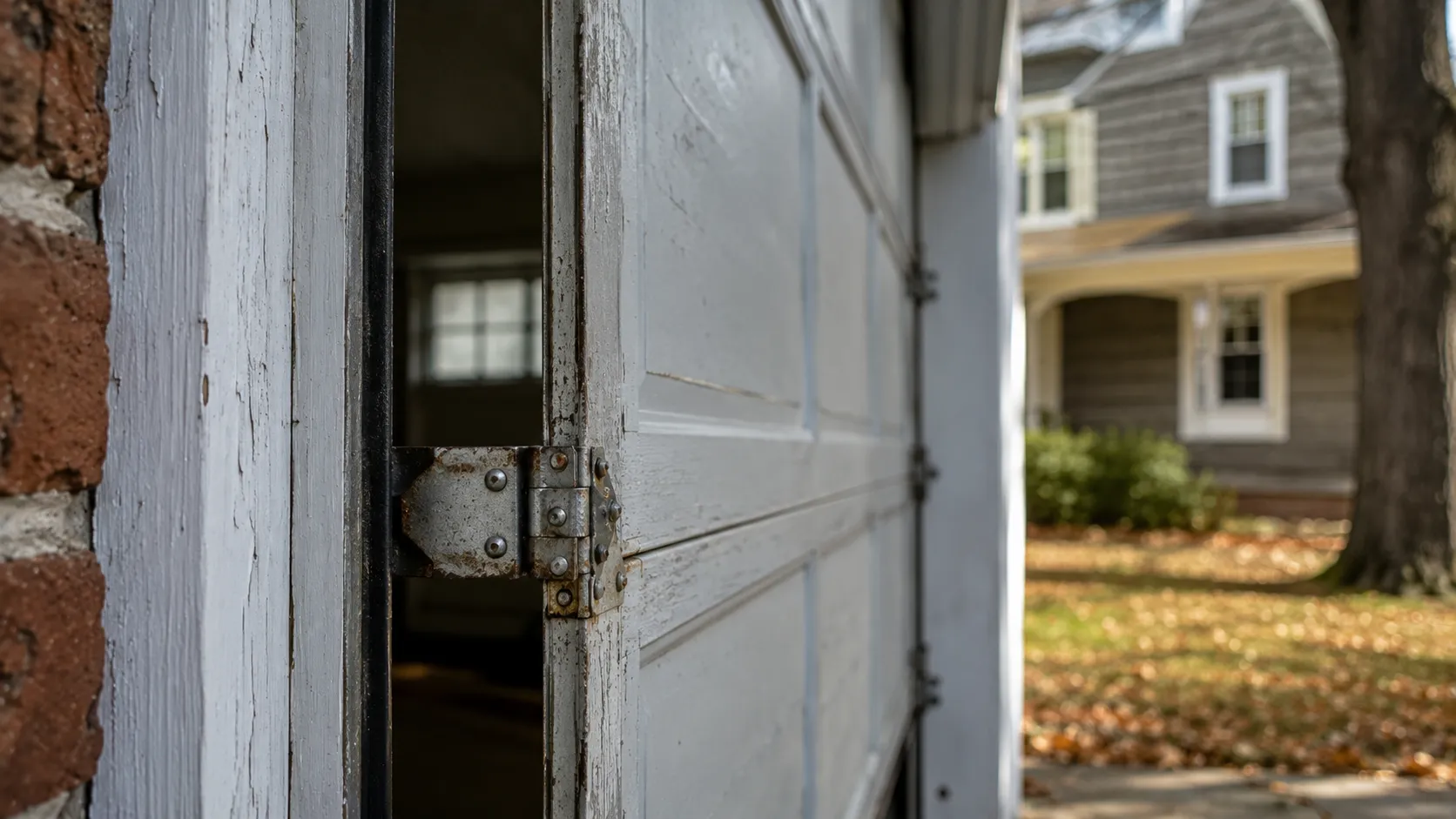
We lube and check seals as part of every service call for this reason, not as an add-on. What we can't fix is a door that's already rusted through at the bottom panel - past a certain point, sealing it again just delays a panel replacement, and we'll tell you that instead of patching it.
Questions
Common questions
My garage door is original to my house from the 1980s. Is that a problem?
Not by itself. A lot of the houses in this service area date to the 1962-2005 window, many from the 1980s and 90s, and plenty of those doors are still running on original springs. The spring itself is the part that wears out with cycles, regardless of the door's age, so that's usually what we check first.
Do you diagnose the problem over the phone before coming out?
No. A broken spring, a bent track, and a failing opener can all look similar from the driveway, and we'd rather see the door than guess. Tell us the symptoms and roughly how old the door is when you call, and we'll bring what's likely needed.
Does the weather here actually affect the door, or is that just a sales line?
It's real but not dramatic - Kent's in a cold, moderate band, not a severe-freeze zone. What we see is moisture getting into seals and panel seams over winter, plus grease stiffening on older torsion springs and chains, which is why we check seals and lubrication on every visit.
Is it worth replacing an old opener instead of repairing it?
Depends on the opener. If it predates 2000, it likely lacks the auto-reverse sensitivity current code expects, and parts for that generation are getting harder to find. If it's already acting up, replacement is often the better call than chasing a repair on an obsolete unit.
Ready when you are
Need a garage door sorted in Kent?
Kent Garage Door Co repairs and installs garage doors, springs and openers in Kent, WA and the surrounding area.