
Guide
What a Garage Door Job Actually Costs in Kent
Kent, WA homeowners: what garage door repairs involve, what to inspect on 1980s-90s builds, and how our cold, wet climate wears down doors and openers.
Local detail
What It Costs
We don't post a flat number on this page, and that's the honest answer, not a dodge. What a job runs depends on what's actually wrong and what door is in front of us. A torsion spring replacement on a standard double door is a different job than an opener swap, and a panel that's rusted through on an older extension-spring setup costs more in parts than the same repair on a newer torsion system. Most of what we see in this area falls somewhere in that range, because the housing stock here runs from 1962 through 2005, with the median build landing around 1983.
That means a lot of doors are old enough to have outlived their original springs and hardware, but not so old that parts are impossible to find. If you call, we'll ask the door's age, whether it's torsion or extension spring, and what it's doing (won't open, off track, noisy) before we quote anything. Anyone who gives you a number over the phone without asking those questions is guessing, and we'd rather not guess.
The area
What to Check
Start with the spring. If it's a single spring mounted above the door on an older extension setup, that's consistent with the earlier end of this area's building years; most newer replacements and homes built later run torsion springs on a shaft above the opening. Look at the cable drums for rust or fraying, especially if the garage isn't heated. Check the weatherstripping along the bottom and sides. This matters more here than in a drier climate, because a cold-moderate band means repeated freeze and thaw through the winter months, and that cycle is what cracks vinyl seals and lets weather seals and draughts follow.
Test the auto-reverse safety feature by placing a 2x4 flat under the door and closing it. If the door doesn't reverse on contact, stop using the opener until that's fixed. Listen for grinding on the rollers. Steel rollers on nylon tracks common in construction from the 1980s and 90s tend to wear at the roller stem first. None of this replaces a hands-on look, but it tells you whether the job is urgent or something you can schedule.
What we find
The Situation
Kent sits within a five-mile ring of Lakeland North, Des Moines, Fairwood, and Covington, and within eight miles of East Renton Highlands, Lakeland South, and Maple Valley. That geography matters less for the door itself and more for how quickly a truck can get to you once a spring lets go on a Sunday. Across the wider service area we work in 43 named communities, and the bulk of that housing was built in the 1980s and 90s, sitting inside the broader 1962-2005 range with a median year of 1983.
That's roughly 228,944 households, of which about 118,902 are owner-occupied houses rather than rentals or condos, and the median household income across that area is $115,750. Practically, that means a lot of original steel doors on torsion hardware that are now 25 to 40 years old, plus a mix of newer builds that skew toward insulated doors and modern openers with rolling-code safety receivers. The mix is wide enough that we don't assume anything about a house's door until we've seen it.
How we work
What the Weather Here Does to It
Kent falls into a cold-moderate climate band, which doesn't mean brutal winters, but it does mean steady freeze-thaw cycling most years rather than one hard freeze and done. That cycling is hard on garage doors in a specific way: grease in the roller bearings and spring coils stiffens in the cold, which puts more strain on the opener motor every time it lifts a door that isn't moving as freely as it should. Weatherstripping takes the same beating. Vinyl seals that were flexible when installed get brittle after a few winters of contracting and expanding, and once they crack, weather seals and draughts follow, which shows up as a cold garage, a damp floor, or both.
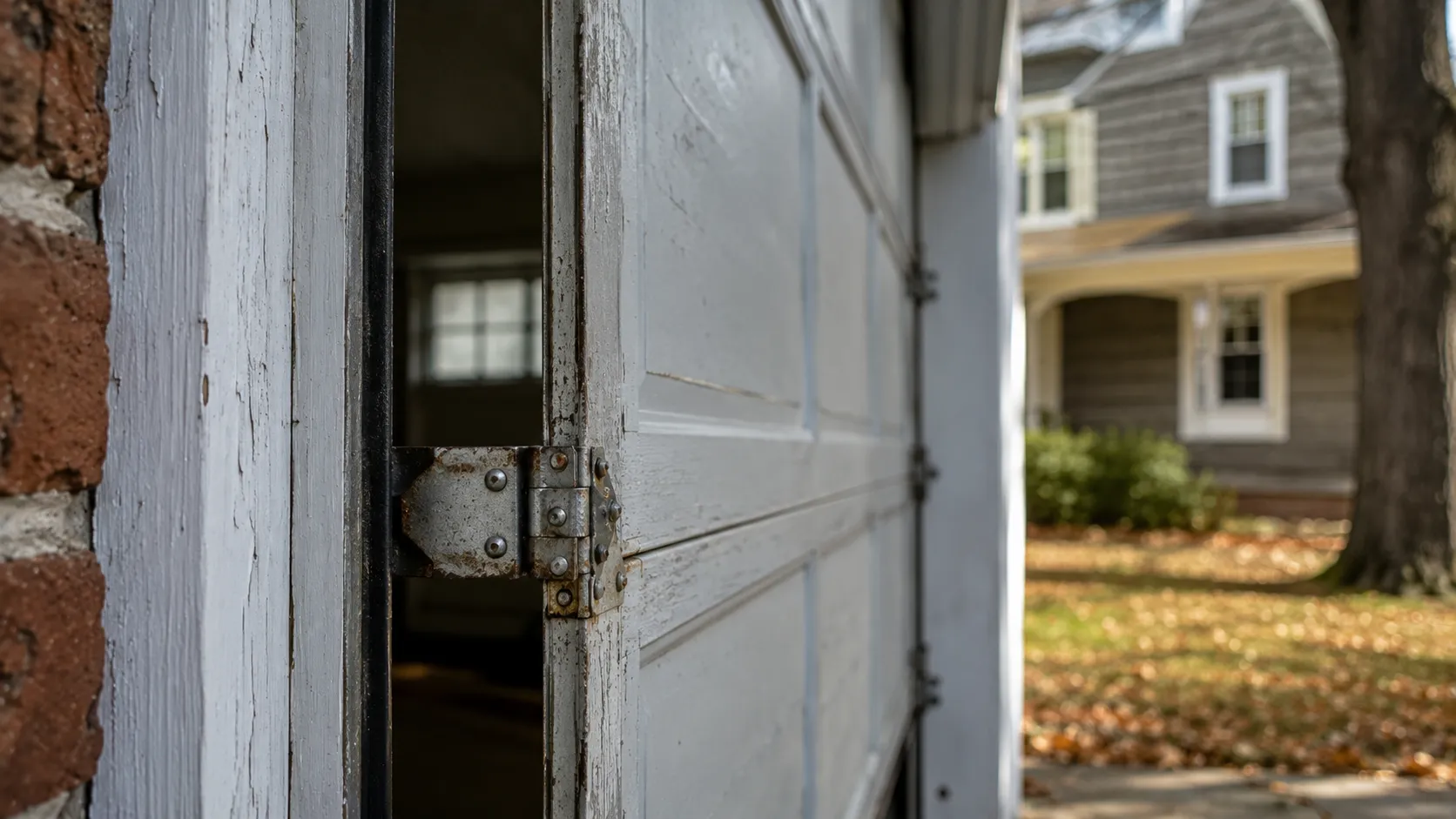
Wood panels on older doors, more common in the earlier end of this area's 1962 build range, can swell slightly with moisture and then shrink back when it dries, which is often what causes a door to bind on one side of the track. None of this is dramatic weather. It's slow wear, and it adds up faster on doors that haven't had the springs or seals touched since they were installed.
Questions
Common questions
How old does a garage door need to be before the springs are a concern?
Torsion springs are usually rated for a number of open-close cycles rather than a calendar age, but in practice most of the springs we replace are 10 to 15 years old. Given the median build year here is around 1983, a lot of original hardware is well past that point even if the door itself still looks fine.
Why does my garage feel colder in winter even with the door shut?
Usually it's the weatherstripping. In a cold-moderate climate like this one, the seals along the bottom and sides go brittle from repeated freeze-thaw cycling, and once they crack, weather seals and draughts follow. It's a cheap fix compared to what it costs to heat a garage that's leaking air.
Is it worth repairing an old wood panel door or should I replace it?
Depends on how much of the panel is affected and whether the frame underneath is still sound. Wood doors from the earlier end of this area's building years can swell and shrink with moisture, and once that warping throws the door out of square in the track, a repair often costs close to what a new insulated steel door would.
Ready when you are
Need a garage door sorted in Kent?
Kent Garage Door Co repairs and installs garage doors, springs and openers in Kent, WA and the surrounding area.