
Guide
When to Fix Your Kent Garage Door and When to Replace It
Kent homes built between 1962 and 2005 carry different door hardware by decade. Here's how to tell if your older garage door is worth repairing or replacing.
Local detail
What It Costs
We can't quote a number here, because what a repair costs depends on what's inside the door. Most houses in the Kent service area went up between 1962 and 2005, with the median build year sitting at 1983, and a door from that era ran on hardware sizes and panel dimensions that changed more than once since. Torsion spring wire gauge, drum size, and track width all shifted by decade, so a shop that guesses instead of measuring often orders the wrong part. If your door dates to the early part of that range, expect the tech to spend real time confirming spring specs before he can even price the job. That's not padding the bill - it's the actual work involved.
The honest limit here: doors older than the mid-1960s sometimes use spring and drum combinations nobody stocks locally anymore, and getting an exact match can take longer than the repair itself. That's rare in Kent given how much of the stock is newer, but it happens on the oldest houses in the area.

The area
What to Check
Before you call anyone, look at four things. First, the springs - torsion springs mounted on a bar above the door versus extension springs on the sides tell you roughly what decade you're dealing with, and that matters more than cosmetic wear. Second, the track: rust pitting or a bent rail means the rollers have been fighting resistance for a while, and that resistance shortens opener life too.
Third, panel condition - steel panels from the 1980s and 90s stock common across this area dent but rarely crack outright, so a dent alone isn't a replacement case. Fourth, the weatherstripping at the bottom panel, which in a cold moderate climate like this one hardens and cracks faster than most owners expect, letting in draft and moisture that then goes to work on the bottom panel steel.
None of these checks require tools, just a flashlight and five minutes. What you find tells you whether you're looking at a simple spring swap or a door fighting you on every front at once.
What we find
The Situation
Across the Kent service area, roughly 118,902 of the 228,944 households own the house they live in, and most of that owner-occupied stock - spread over the 43 named communities from Lakeland North to Medina - went up in the 1980s and 90s. A door installed then is now 30 to 45 years old, well past the point where most manufacturers still support the original opener or spring hardware.
That doesn't automatically mean replace it. A door with a straight track, solid panels, and a spring that's simply worn out is usually worth repairing regardless of age, because the part that fails first is rarely the part that's expensive. What changes the math is when two or three systems fail at once - spring, opener, and panel - which happens more often on doors from the earlier end of that 1962-2005 window than on the newer end of it.
How we work
What the Weather Here Does to It
Kent sits in a cold moderate climate band, which doesn't mean brutal winters, but it does mean repeated freeze-thaw cycling on any door that faces north or west without much direct sun. That cycling is what actually kills weatherstripping and pushes moisture into the bottom panel seam, not one hard freeze.
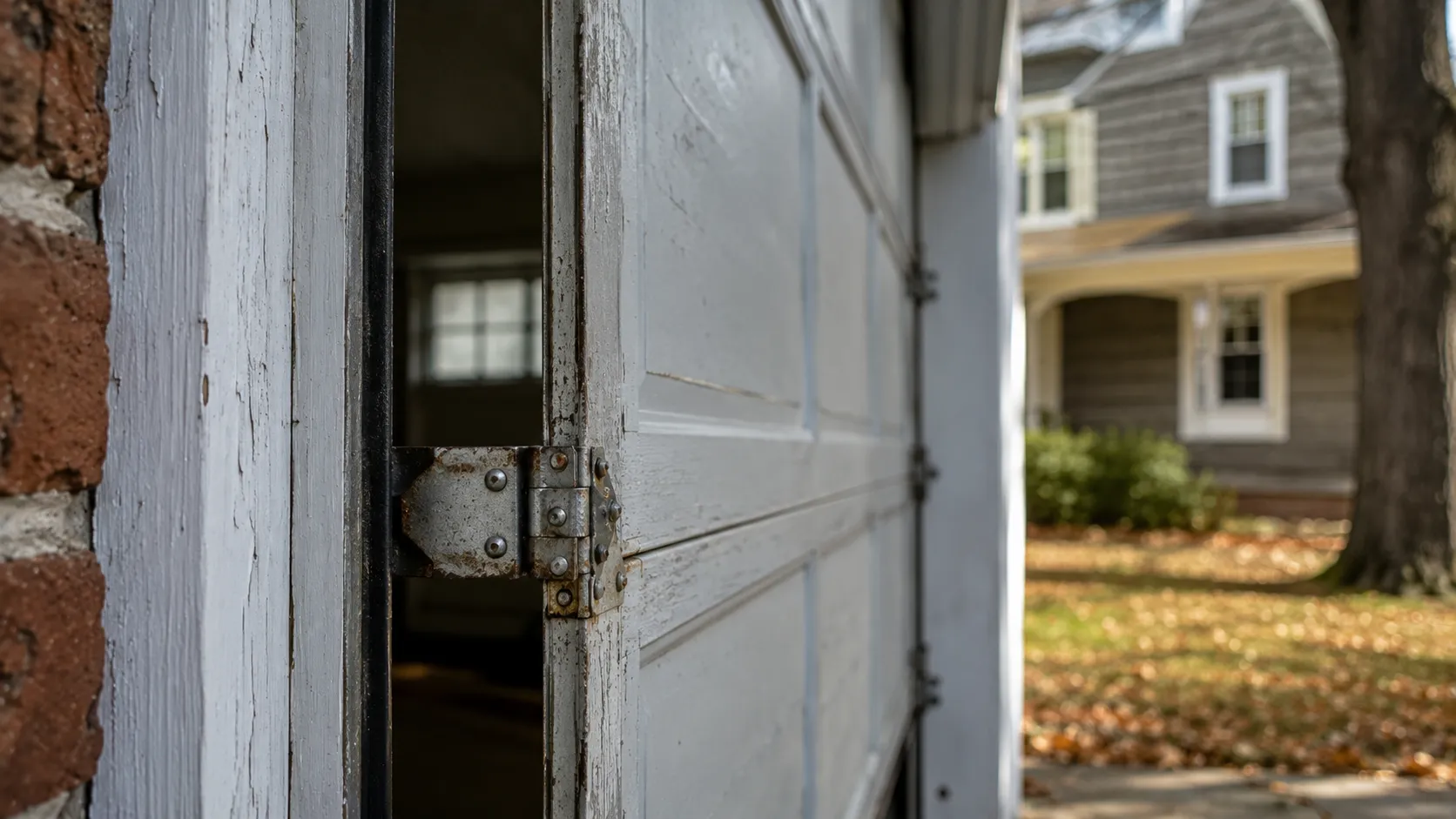
Steel panels from the 1980s and 90s don't rust through quickly, but the fasteners and hinges holding them do corrode faster in a garage that stays damp and cool most of the year. If your door has never had the weatherstripping replaced, that's usually the first thing worth doing, and it's cheap insurance against the moisture damage that leads to panel repairs that aren't cheap at all.
Questions
Common questions
Is a garage door from the 1980s still worth repairing?
Usually yes. Most houses in the Kent area were built in the 1980s and 90s, and a door from that stretch typically has a straight track and standard torsion hardware even if the spring or opener has worn out. Unless the panels are cracked or the track is badly bent, a repair costs less than replacement and gets you several more years out of a door that's otherwise sound.
How does the weather here affect an older door?
Kent's cold moderate climate puts doors through repeated freeze-thaw cycling rather than one hard freeze, which is what actually breaks down weatherstripping and corrodes hinges and fasteners over time. If your door has never had the seal replaced, that's usually the first sign of trouble, well before the panels or springs show wear.
When does an older door stop being worth fixing?
When two or three systems fail at the same time - spring, opener, and panel, for example - the repair cost stacks up fast enough that replacement often makes more sense, especially on doors from the earlier end of the 1962-2005 range. A single failed part on an otherwise sound door is almost always worth fixing.
Can you get parts for a really old garage door?
Most of the time, yes, but doors from before the mid-1960s sometimes used spring and drum sizes that nobody stocks locally anymore. In that case the tech has to source an exact match, which can take longer than the repair itself. It's the one real limit on fixing very old doors quickly.
Ready when you are
Need a garage door sorted in Kent?
Kent Garage Door Co repairs and installs garage doors, springs and openers in Kent, WA and the surrounding area.